STRATÉGIE DANS UN LABYRINTHE |
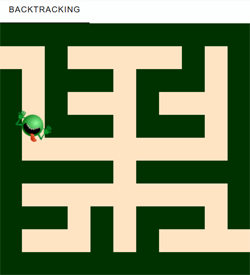
Dans ton programme, tu détermines les cellules voisines en sélectionnant, parmi les quatre cellules adjacentes, celles qui ne se trouvent ni sur un mur ni à l'extérieur de la grille. Programme: #Labyrinth.py from gamegrid import * def createMaze(): global maze maze = GGMaze(11, 11) for x in range(11): for y in range(11): loc = Location(x, y) if maze.isWall(loc): getBg().fillCell(loc, Color(0, 50, 0)) else: getBg().fillCell(loc, Color(255, 228, 196)) refresh() def getNeighbours(node): neighbours = [] for loc in node.getNeighbourLocations(0.5): if isInGrid(loc) and not maze.isWall(loc): neighbours.append(loc) return neighbours def search(node): global targetFound, manual if targetFound: return visited.append(node) # push alien.setLocation(node) refresh() delay(500) # Check for termination if node == exitLocation: targetFound = True for neighbour in getNeighbours(node): if neighbour not in visited: backSteps = [node] backStepsList.append(backSteps) backSteps.append(neighbour) search(neighbour) # recursive call backSteps.reverse() if not targetFound: for loc in backSteps[1:]: setTitle("Must go back...") alien.setLocation(loc) refresh() delay(500) if manual: setTitle("Went back...") else: setTitle("Went back. Find target...") backStepsList.pop() visited.pop() # pop manual = True targetFound = False visited = [] backStepsList = [] makeGameGrid(11, 11, 40, False) setTitle("Labyrinth") show() createMaze() startLocation = maze.getStartLocation() exitLocation = maze.getExitLocation() alien = Actor("sprites/alieng.png") addActor(alien, startLocation) search(startLocation) setTitle("Target found") |
À RETENIR... |
Il est intéressant de comparer la stratégie utilisée par un être humain avec celle d'un ordinateur pour résoudre un labyrinthe. Un joueur humain peut reconnaître d'un seul coup d'œil la situation dans son ensemble et en déduire une stratégie pour atteindre la sortie le plus rapidement possible. Il utilise ainsi une vision globale, caractéristique de la perception humaine, dont ton programme informatique ne dispose pas. Le programme, en revanche, n'analyse que la situation locale. Mais il se souvient très précisément des chemins déjà parcourus et explore de manière systématique de nouveaux chemins pour atteindre son objectif. La situation devient toutefois plus favorable à l'ordinateur lorsque l'être humain ne dispose plus d'une vue d'ensemble, par exemple lorsqu'il se trouve lui-même à l'intérieur du labyrinthe ou lorsque le nombre de cellules augmente considérablement. |
LE PROBLÈME DES 8 DAMES |
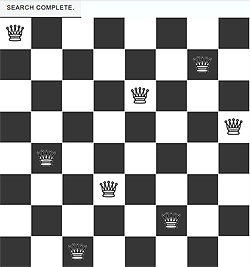
Ton algorithme s'arrête dès qu'il a trouvé la première solution. Il existe 92 solutions différentes au problème des huit dames. Selon les performances de l'ordinateur ou de l'éditeur Web, la recherche d'une solution peut prendre de quelques secondes à quelques minutes. Programme: #Quenns.py from gamegrid import * n = 8 # number of queens def getNeighbours(node): squares = [] # list of occupied squares for i in range(n): if node[i] != -1: squares.append(Location(node[i], i)) forbidden = [] # list of forbidden squares for location in squares: a = location.x b = location.y for x in range(n): forbidden.append(Location(x, b)) # same row for y in range(n): forbidden.append(Location(a, y)) # same column for loc in getDiagonalLocations(location, True):#diagonal up forbidden.append(loc) for loc in getDiagonalLocations(location, False):#diagonal down forbidden.append(loc) allowed = [] # list of all allowed squares = all - forbidden for i in range(n): for k in range(n): loc = Location(i, k) if not loc in forbidden: allowed.append(loc) neighbourNodes = [] for loc in allowed: neighbourNode = node[:] i = loc.y # row k = loc.x # col neighbourNode[i] = k neighbourNodes.append(neighbourNode) return neighbourNodes def search(node): global found if found or isDisposed(): return visited.append(node) # node marked as visited # Check for solution if not -1 in node: found = True drawNode(node) for s in getNeighbours(node): search(s) visited.pop() def drawBoard(): for i in range(n): for k in range(n): if (i + k) % 2 == 0: getBg().fillCell(Location(i, k), Color.white) def drawNode(node): removeAllActors() for i in range(n): addActorNoRefresh(Actor("sprites/chesswhite_1.png"), Location(node[i],i)) refresh() makeGameGrid(n, n, 600 // n, False) setBgColor(Color.darkGray) drawBoard() show() setTitle("Searching. Please wait..." ) visited = [] found = False startNode = [-1] * n # all squares empty search(startNode) setTitle("Search complete. ") |
 |
 |
 |